
GMB Helper.ai

Fake and spam Google reviews

Remove fake Google reviews with a case Google actually acts on

Flagging a review with three dots and hoping is how most fake reviews stay up. GMB Helper.ai names the exact policy the review breaks, writes the argument in the words Google’s form asks for, files the report and the appeal from your browser, and tells you the day the review is gone.

Report a fake review
  • Up to 25 reviews in one case
  • Report and appeal filed for you
  • Removal confirmed from Google
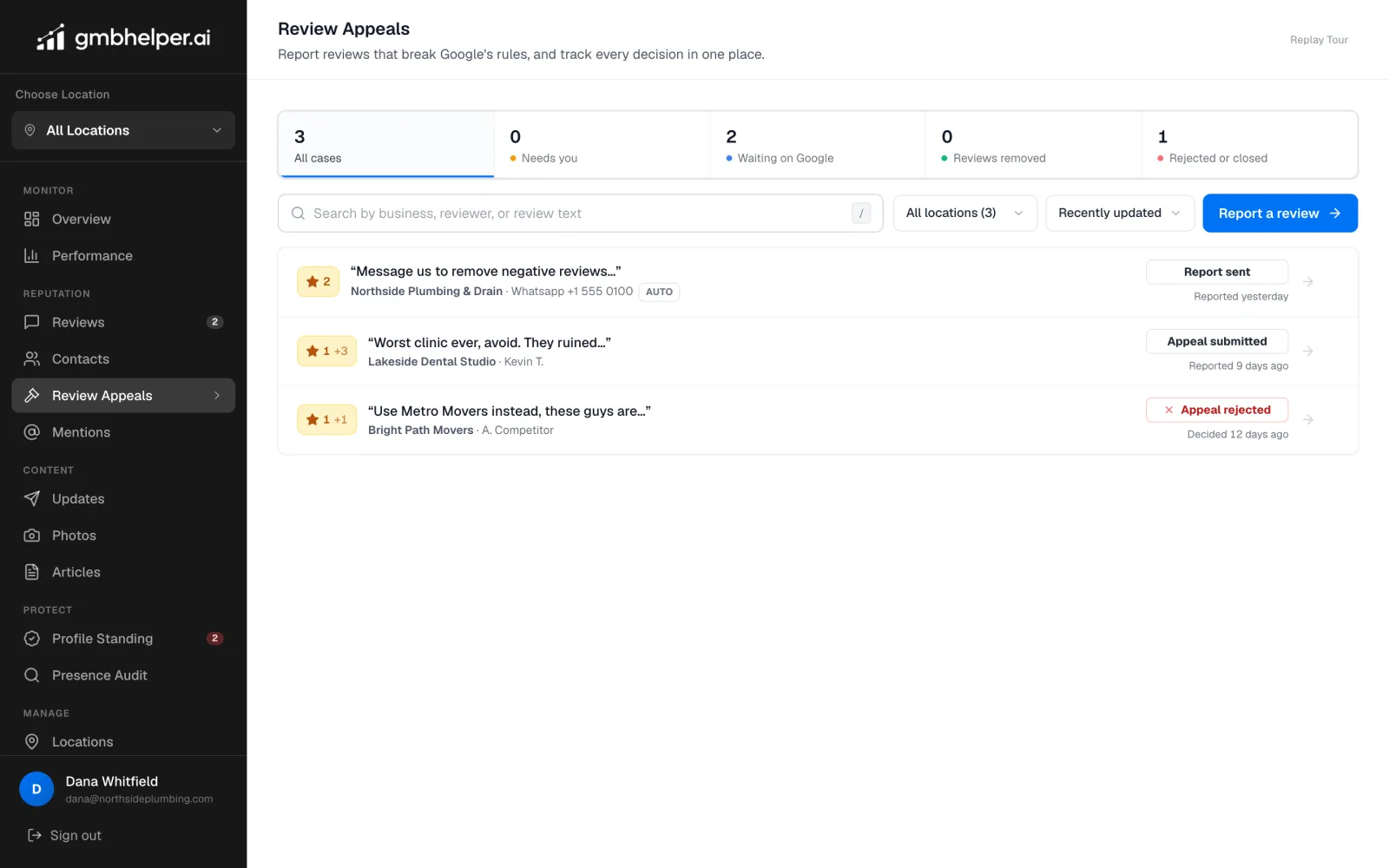
GMB Helper Review Appeals screen showing a report sent for a review-removal solicitation, an appeal submitted for a four-review attack, and one appeal Google rejected
Cases move from report to appeal to a recorded outcome, removed or kept.

What is going on

Why the three-dot flag does nothing

Every Google review has a Report option. Almost everyone uses it, and almost nothing happens, because the flag arrives with no context: no policy named, no explanation, no evidence that the reviewer was never a customer. Google’s team sees a one-star review and a business owner who does not like it, and one-star reviews are not against the rules.

What Google removes is a review that breaks a specific policy: fake engagement from someone who never had the experience, a conflict of interest such as a competitor or former employee, off-topic content, harassment, personal information, impersonation, or restricted content. The report has to say which policy and why, and the appeal has to say it again, better, when the first flag is ignored.

The process is also slow and easy to lose track of. Google has no API for reporting or appealing reviews, so it all happens inside the Reviews Management Tool, one review at a time, with a waiting period after the report and a one-time appeal after that. A business hit by six fake reviews on a Tuesday needs a case, not six browser tabs.

How GMB Helper.ai handles it

From a suspicious review to a confirmed removal

One case covers up to 25 reviews from a single profile, which fits a same-day spam wave and stays reviewable. Each review keeps its own outcome, so a case can be an honest partial win.

  1. 1

    Suspicious reviews get flagged as they arrive

    Every new negative review is read for reportable signals: text that looks like it came from someone who was never a customer, a competitor or former employee, the same text posted across several businesses, or offers to remove or sell reviews. A flagged review holds its automatic reply and is one click from a case.

  2. 2

    Pick the reviews

    Choose the reviews that belong together. If they landed on the same day, use similar wording, or come from empty accounts, the case is written as one coordinated attack rather than separate complaints, which is a much stronger frame for Google.

  3. 3

    The policy and the reason, written for you

    For each review the case names the policy Google’s form asks about and writes the two to four sentence explanation as an advocate for the business. Add your own context, such as no record of this person in your bookings, and the draft leads with it.

  4. 4

    An honest read before you file

    Each review is rated as a strong, weak, or not-a-violation case. A genuine complaint from a real customer is told to you as exactly that, so you reply to it instead of burning an appeal on it.

  5. 5

    Filed in your browser

    The GBP Autopilot extension opens Google’s Reviews Management Tool and files the report for each review. Turn on auto-report for a location and new 1 to 3 star reviews are reported without you opening the app.

  6. 6

    The appeal is ready when the flag is ignored

    One appeal letter covers every review in the case and is drafted at report time, with an evidence checklist of what to attach. If the review is still up after three days you get a reminder that the appeal is ready to file.

  7. 7

    Removal is confirmed, not assumed

    The review’s presence on Google is checked and a disappearance is confirmed across several fetches before it counts. A removed review closes its line in the case and you get the email. A review Google kept is recorded as kept.

The policies Google will remove a review for

Google’s review policies are narrower than most owners expect. A bad review from a real customer stays, even if it is unfair. What comes down is a review that breaks one of these rules, and the report is far more likely to land when it names the rule and explains the match.

  • Fake engagement: the reviewer never had the experience, or the review was paid for or traded
  • Conflict of interest: a competitor, a former employee, or someone with a stake in the outcome
  • Off-topic: a political rant, a complaint about a different business, or nothing to do with the service
  • Harassment, hate speech, or offensive content aimed at staff or the owner
  • Personal information: full names, phone numbers, or addresses of employees or customers
  • Impersonation, restricted or illegal content, and sexually explicit content

Coordinated attacks need a coordinated case

Six one-star reviews in an afternoon from accounts with no other activity are not six separate opinions. Reported one at a time they look like six grumpy customers. Reported as one case, with the timing, the matching phrasing, and the empty reviewer profiles laid out, they look like what they are.

GMB Helper.ai writes that narrative for the case and reuses it in the appeal letter. When the same review text turns up on other businesses in the platform, that duplicate is cited too.

Auto-report for the reviews you would always report anyway

Some businesses are hit often enough that they want every new 1 to 3 star review reported the moment it lands. Auto-report is a per-location switch, off by default. When it is on, a qualifying new review opens its own case with the policy and reason drafted, and the extension files the report from any browser where it is installed and signed in to the managing Google account. You get the reported email, then the appeal-ready reminder if the review survives.

Reviews that are clearly genuine, and cases where a reviewer is demanding payment, are kept out of the automatic path so a human looks first.

Meanwhile, answer the reviews that are real

Removal takes days at best, and the review is public the whole time. The same account drafts a reply in your voice for every review, and Hybrid mode holds anything under four stars for your approval while publishing the rest. A calm, specific owner reply under a fake review often does more for the next customer than the removal does.

Straight answers

What we will not promise

  • Google decides what comes down. We build the strongest case and track it; outcomes are recorded as removed or kept, never rounded up.
  • There is no API for reporting or appealing a review. Filing happens in your browser with the GBP Autopilot extension, or by hand with the drafts the case gives you.
  • A negative review from a real customer is not a policy violation. If the case reads it that way, it will tell you to reply instead of report.
  • Google gives one appeal per review. The case does not let you spend it twice.

Questions

Fake review questions, answered plainly.

Can you guarantee a fake review gets removed?

No, and nobody can. Google makes the call. What changes the odds is naming the exact policy, explaining the match in Google’s own terms, framing a wave as one attack, and filing the appeal when the flag is ignored. The case does all of that and records the honest outcome.

How long does Google take to remove a reported review?

The first flag result often takes a few days; an appeal can take longer. The case reminds you when each stage has sat too long, checks Google for the review’s presence, and emails you the day it is confirmed gone.

Can I report a one-star review that is real but unfair?

You can, but it will stay up, and the case will tell you so before you file. Unfair is not a policy violation. Reply to it instead, and the same account drafts that reply in your voice.

We were hit by a burst of fake reviews. Do I report them one by one?

No. Put up to 25 reviews from the same profile into one case. It is written as a coordinated attack, one appeal letter covers all of them, and each review still gets its own removed or kept result.

What does auto-report do?

With auto-report on for a location, every new 1 to 3 star review opens a case with the policy and reason drafted, and the GBP Autopilot extension files the report in a browser signed in to the managing Google account. You get an email when it is reported and a reminder to appeal if it is still up after three days.

Do I need the Chrome extension?

Only for filing. Detection, drafting, the evidence checklist, tracking, and reminders all live in the app. Without the extension, the case gives you the policy and reason to paste into Google’s tool yourself.

Get the fake ones off your profile.

Connect the profile in the 7-day free trial, open a case on the reviews that should not be there, and let the report go out today.